
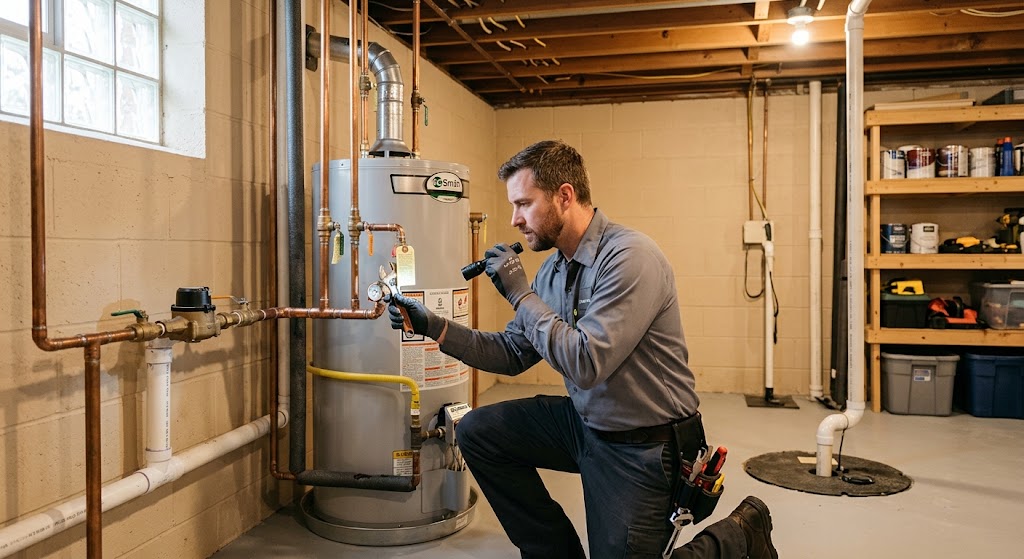
The Critical Role of Cross-Connection Control in Commercial Infrastructure
In commercial, industrial, and multi-tenant facilities, protecting the public potable drinking water supply from cross-contamination is a strict regulatory mandate enforced under the Safe Drinking Water Act (SDWA), the International Plumbing Code (IPC), and the Uniform Plumbing Code (UPC). Cross-connections exist anywhere potable water piping interfaces with non-potable liquids, chemical solutions, industrial processes, cooling towers, or boiler feeds.
Facility managers, hospital engineers, and property owners nationwide rely on certified backflow technicians through the Plumber800 National Network to ensure continuous code compliance, accurate manifold calibration, and timely annual municipal reporting.
Backflow Mechanics: Backsiphonage vs. Backpressure
Reverse flow inside commercial water mains develops through two distinct physical mechanisms:
- Backsiphonage: Occurs when negative or sub-atmospheric pressure develops upstream in the municipal distribution main. Common catalysts include a municipal water main rupture, aggressive fire hydrant drafting during fire suppression, or scheduled utility maintenance. The resulting vacuum siphons contaminated process water backwards into the drinking supply.
- Backpressure: Occurs when downstream mechanical pressure generated within a building exceeds incoming utility supply pressure (normally 45 to 75 PSI). High-pressure steam boilers, chilled water circulation pumps, pneumatic booster systems, and elevated storage tanks are common sources of backpressure.
Core Commercial Backflow Prevention Assemblies
Plumbing codes classify backflow preventers according to health hazard risk:
- Reduced Pressure Zone (RPZ) Assemblies: The gold standard for high-hazard installations where reverse flow poses a toxic or biological danger (chemical plating, medical facilities, commercial boilers). RPZs utilize two independently acting check valves separated by an intermediate hydraulically operated relief valve venting directly to the atmosphere.
- Double Check Valve Assemblies (DCVA): Approved exclusively for low-hazard (non-health) applications, such as commercial dry or wet fire sprinkler systems without chemical additives.
- Pressure Vacuum Breakers (PVB): Designed solely for continuous-pressure backsiphonage protection, widely installed on commercial turf irrigation and landscape headers. PVBs cannot protect against backpressure conditions.
Annual Backflow Certification Due or Valve Leaking?
Connect immediately with licensed, state-certified backflow assembly testers and mechanical contractors in your jurisdiction.
Step-by-Step RPZ Field Differential Testing Procedure
Certified backflow assembly testers (ASSE 5110 certified) employ calibrated 3-valve or 5-valve differential pressure gauges to measure valve spring tension and relief port actuation:
- Relief Valve Opening Differential: High and low test hoses connect to test cocks #2 and #3. The differential pressure across Check Valve 1 is slowly reduced until the hydraulic relief valve discharges to the atmosphere. Under IPC/ASSE standards, the relief port must open at a minimum of 2.0 PSID (Pounds per Square Inch Differential).
- Check Valve 2 Tightness: High-pressure supply is introduced between test cocks #3 and #4 to ensure zero backpressure seepage across the downstream disc.
- Check Valve 1 Static Differential: The static pressure drop across Check Valve 1 is measured; it must maintain at least 3.0 PSID higher than the relief valve opening point.
Regional Testing Protocols & Code Compliance
In regions across the Pacific Northwest governed by stringent environmental and public health standards (such as WAC 246-290-490 administered by the Washington State Department of Health), municipal water purveyors strictly enforce mandatory annual assembly testing, certified backflow tagging, and immediate submittal of test logs. Commercial facility managers in the region can consult verified state cross-connection guidance through Washington Plumbing Best to review local administrative requirements and schedule annual backflow certifications.
Common Failure Modes During Annual Inspections
When an RPZ or Double Check assembly fails its annual differential test, the cause is typically one of three physical issues:
- Particulate Fouling on Valve Seats: Mineral scale, sand particles, or pipe rust become lodged between the rubber elastomeric disc and the bronze/stainless seat, preventing an airtight seal.
- Weakened or Corroded Internal Springs: Over hundreds of thousands of pressure cycles, internal stainless steel check valve springs lose tension, causing the relief valve to trip prematurely.
- Perforated Sensing Diaphragm: Tears or pinholes in the internal elastomer diaphragm cause continuous discharge from the air gap drain funnel.